

 VIE
VIE📌 Summary
- HACCP is a preventive food safety management system that identifies and controls hazards throughout the production process
- It is based on the 7 HACCP Principles and 12 implementation steps established by the Codex Alimentarius Commission, forming the foundation of standards such as ISO 22000, FSSC 22000, BRCGS, and IFS
- The HACCP Standard applies to organizations across the food supply chain, from manufacturing and processing to packaging, logistics, and food service
- Effective HACCP implementation requires trained personnel, standardized procedures, CCP monitoring, and continual improvement
1. What Is the HACCP Standard?
HACCP (Hazard Analysis and Critical Control Points) is a preventive food safety management system designed to identify, evaluate, and control food safety hazards throughout the entire production process—from raw material receiving and processing to storage and distribution.
HACCP focuses on preventing hazards at their source by identifying Critical Control Points (CCPs) and implementing appropriate control measures at each stage of production. By doing so, organizations can minimize food safety risks, reduce nonconforming products, and improve overall operational performance.
1.1 History and Development of HACCP
HACCP was developed to achieve the highest level of food safety assurance through a preventive approach. Its development can be traced through the following key milestones:
- 1960s: Pillsbury Company, in collaboration with NASA and the U.S. Army, developed the HACCP concept to ensure that food for space missions was free from pathogens and harmful contaminants.
- 1971: HACCP was introduced for the first time at the U.S. National Conference on Food Protection, marking a major shift toward preventive food safety management.
- 1974: The U.S. Food and Drug Administration (FDA) officially adopted HACCP principles for the production of low-acid canned foods.
- 1993: The Codex Alimentarius Commission incorporated HACCP into CAC/RCP 1-1969, establishing it as the global foundation for food safety management guidelines and regulatory frameworks.
Today, HACCP is recognized as the cornerstone of modern food safety management systems. It is widely accepted by governments, regulatory authorities, and international organizations, and serves as the foundation for globally recognized standards such as ISO 22000, FSSC 22000, BRCGS, IFS, as well as numerous food safety regulations worldwide.
In Vietnam, the HACCP principles have been adopted as TCVN 5603:2023, which is equivalent to Codex Alimentarius CXC 1-1969, Rev.5 (2020).
1.2 Which Organizations Should Implement HACCP?
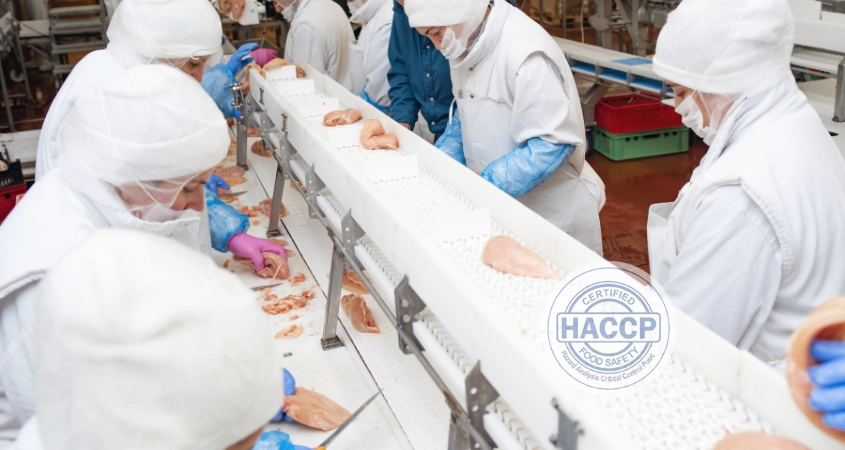
HACCP Standard is recommended for organizations involved in any stage of the food supply chain, from manufacturing and processing to packaging, storage, and distribution. Typical industries include:
- Food manufacturing and processing companies: Seafood, meat, dairy products, beverages, confectionery, instant noodles, seasonings, sauces, dietary supplements, and other food products.
- Agricultural processing and food packaging companies: Fresh fruits and vegetables, rice, cereals, grains, and food packing facilities.
- Food service providers: Restaurants, hotels, catering companies, institutional kitchens, schools, and hospitals.
- Manufacturers of food contact packaging: Bottles, jars, containers, trays, films, and other food packaging materials intended for direct food contact.
- Food logistics and distribution companies: Cold storage facilities, refrigerated warehouses, transportation providers, distribution centers, and food exporters.
1.3 HACCP Requirements by Industry and Applicable Regulations
Certain sectors of the food industry are subject to specific HACCP regulations or guidelines, particularly organizations exporting food products or supplying international markets.
| Industry | Applicable Regulation / Guideline | Remarks |
| Juice | FDA 21 CFR Part 120 | Juice HACCP |
| Seafood | FDA 21 CFR Part 123 | Seafood HACCP |
| Meat & Poultry | USDA 9 CFR Part 417 | Mandatory HACCP implementation |
| Canned Foods | FDA 21 CFR Parts 113 & 114 | Industry-specific regulatory requirements |
| European Union (EU) | EC No. 852/2004 | Food safety management based on HACCP principles |
| Global Retail Supply Chains | BRCGS, IFS, SQF | HACCP serves as the foundation of these food safety standards |
Note: For food exporters to the United States, Juice HACCP and Seafood HACCP are mandatory FDA requirements for the respective product categories. In the European Union and global retail supply chains, organizations are expected to implement food safety management systems based on the principles of HACCP.
1.4 Key HACCP Terminology
The following terms are commonly used in HACCP implementation:
- PRP (Prerequisite Program): Basic environmental and operational conditions required to maintain a hygienic production environment, including facility sanitation, pest control, personnel hygiene, and equipment maintenance.
- OPRP (Operational Prerequisite Program): Control measures identified through hazard analysis that are essential for preventing or reducing food safety hazards but are not classified as Critical Control Points (CCPs).
- CCP (Critical Control Point): A step at which control is essential to prevent, eliminate, or reduce a food safety hazard to an acceptable level.
1.5 HACCP Standard PDF
SQS Global has compiled a collection of HACCP reference documents to help organizations implement, operate, and continually improve their food safety management systems.
>> DOWNLOAD NOW: HACCP STANDARD PDF
2. Benefits of HACCP
According to the World Health Organization (WHO), an estimated 600 million people suffer from foodborne illnesses each year, resulting in approximately 420,000 deaths worldwide. Foodborne incidents continue to occur globally, posing significant risks to public health, business reputation, and operational continuity.
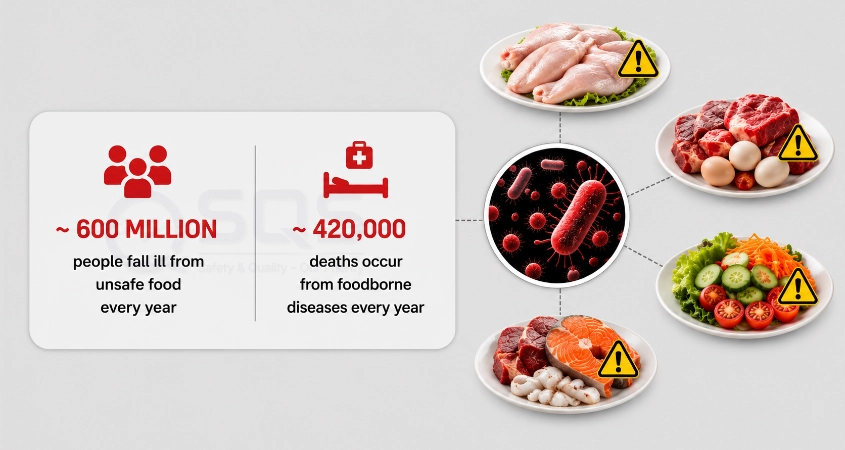
Against this backdrop, HACCP is more than a food safety management system. It provides organizations with a preventive approach to identifying, assessing, and controlling food safety hazards throughout the production process. Implementing HACCP offers the following key benefits:
- Effectively controls food safety hazards throughout the production process.
- Reduces nonconforming products, minimizing waste and corrective costs.
- Improves product traceability and enables faster response to food safety incidents.
- Enhances customer, regulatory, and stakeholder confidence.
- Provides a strong foundation for implementing standards such as ISO 22000, FSSC 22000, and BRCGS.
- Expands market access by meeting the food safety requirements of international customers and export markets.
3. HACCP Framework and the 7 Principles
According to the Codex Alimentarius (CXC 1-1969, Rev.5-2020), the HACCP system is developed through a 12-step implementation process, consisting of 5 preliminary steps and the 7 HACCP Principles. Together, these provide a systematic framework for identifying, evaluating, and controlling food safety hazards throughout the production process.
The 5 preliminary steps establish the foundation for developing an effective HACCP plan, while the 7 HACCP Principles provide the methodology for hazard analysis, control measure implementation, and ongoing system effectiveness.
| 5 Preliminary Steps | 7 HACCP Principles |
| Assemble the HACCP Team | Principle 1: Conduct a Hazard Analysis |
| Describe the Product | Principle 2: Determine Critical Control Points (CCPs) |
| Identify the Intended Use | Principle 3: Establish Critical Limits |
| Construct the Process Flow Diagram | Principle 4: Establish Monitoring Procedures |
| Verify the Process Flow Diagram On-site | Principle 5: Establish Corrective Actions |
| Principle 6: Establish Verification Procedures | |
| Principle 7: Establish Documentation and Record-Keeping Procedures |
This article focuses on the 7 HACCP Principles, which form the core of the HACCP system and are essential for organizations implementing and maintaining an effective food safety management system.
Principle 1: Conduct a Hazard Analysis
Hazard analysis is the first and most critical step in the HACCP system. Organizations must identify and evaluate all potential food safety hazards that may occur throughout the production process, from raw material receiving to finished products.
Food safety hazards are generally classified into three categories:
- Biological Hazards: Bacteria, viruses, molds, parasites, and other pathogenic microorganisms.
- Chemical Hazards: Pesticide residues, veterinary drug residues, unauthorized food additives, cleaning chemicals, allergens, and other chemical contaminants.
- Physical Hazards: Foreign materials such as metal fragments, glass, plastic, wood, stones, or other physical contaminants.
After identifying potential hazards, organizations should assess the associated risks and establish appropriate control measures to prevent, eliminate, or reduce them to an acceptable level.
Principle 2: Determine Critical Control Points (CCPs)
A Critical Control Point (CCP) is a step in the process where control is essential to prevent, eliminate, or reduce a food safety hazard to an acceptable level. Correctly identifying CCPs helps organizations prevent food safety incidents while reducing quality control costs.
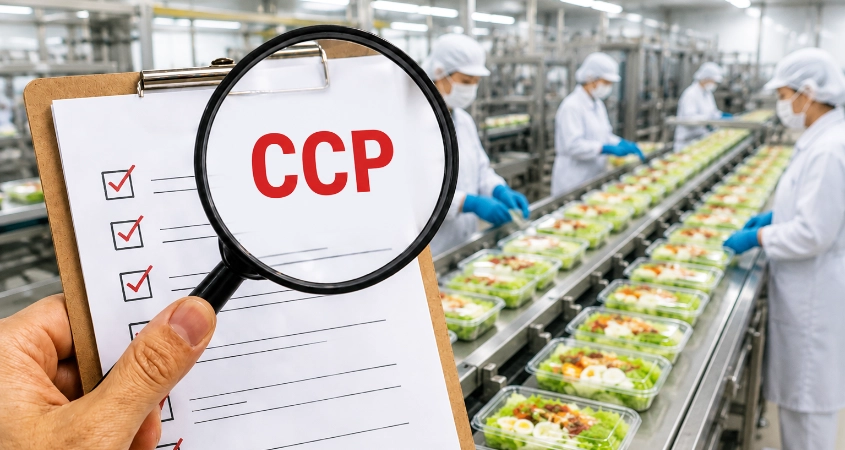
To identify CCPs accurately, organizations should use the Codex Decision Tree, which helps distinguish CCPs from PRPs and OPRPs.
Principle 3: Establish Critical Limits
For each identified CCP, critical limits must be established to determine whether the process is under control. These limits should be based on scientific evidence, regulatory requirements, or recognized industry standards.
Common critical limits include:
- Temperature and Time: The product core temperature should reach at least 75°C to eliminate harmful microorganisms, while the required holding time must also be monitored.
- pH and Water Activity (aw): Controlling pH and water activity (aw) helps inhibit microbial growth and reduce the risk of spoilage.
Principle 4: Establish Monitoring Procedures
Organizations should continuously monitor each CCP to ensure that critical limits are consistently met. An effective monitoring system should clearly define:
- What will be monitored
- How it will be monitored, including the measuring methods and equipment used
- When monitoring will be performed and at what frequency
- Who is responsible for carrying out the monitoring activities
Principle 5: Establish Corrective Actions
Whenever monitoring indicates that a CCP is out of control, corrective actions must be implemented immediately to prevent unsafe products from reaching the market.
Corrective actions typically include:
- Immediate actions: Stop the affected process and identify the root cause.
- Product disposition: Evaluate, segregate, reprocess, or dispose of affected products as appropriate.
- System improvement: Correct equipment or process failures and retrain personnel when necessary
Principle 6: Establish Verification Procedures
Verification activities are conducted to confirm that the HACCP system is functioning effectively and continues to meet established food safety requirements.
Verification may include:
- Internal audits.
- Record review.
- Calibration of monitoring and measuring equipment.
- Product testing and laboratory analysis.
- Validation following significant process changes
Organizations should establish and maintain comprehensive documentation and records to demonstrate compliance with HACCP requirements, support product traceability, and facilitate system evaluation and continual improvement.
Typical records include the HACCP Plan, CCP monitoring records, corrective action records, verification results, training records, and other documents related to the operation of the HACCP system.
4. Best Practices for Effective HACCP Implementation
Developing a HACCP plan is only the first step. In practice, many organizations still struggle to achieve effective system performance due to unstandardized procedures, insufficient personnel training, or the lack of regular review and continual improvement.
Based on SQS Global’s implementation experience, in addition to complying with the 7 HACCP Principles defined in Codex Alimentarius (CXC 1-1969, Rev.5-2020), organizations should adopt the following best practices to maintain system effectiveness and improve their readiness for customer and certification audits.
4.1 Personnel Training and Competency Development
Many organizations regard HACCP training primarily as a certification requirement. However, from SQS Global’s perspective, the effectiveness of a training program is measured not by the number of certificates issued, but by employees’ ability to identify food safety hazards and respond appropriately when a Critical Control Point (CCP) exceeds its established critical limits.

Instead of providing the same training to all employees, organizations should develop role-specific training programs for functions such as QA, QC, Production, and Maintenance. During customer or certification audits, auditors often verify personnel competency through on-site interviews rather than relying solely on training records.
4.2 Standardize Operating Procedures (SOPs)
All food safety-related activities should be standardized through Standard Operating Procedures (SOPs).
Each SOP should clearly define the work sequence, monitoring methods, acceptance criteria, and corrective actions for deviations. Well-documented SOPs reduce reliance on individual experience and ensure that Critical Control Points (CCPs) are consistently controlled while supporting traceability during HACCP audits.
Based on SQS Global’s implementation experience, organizations should review and update SOPs whenever there are changes to raw materials, equipment, or production processes to ensure that control measures remain effective under actual operating conditions.
4.3 Apply Technology to HACCP Monitoring
Modern HACCP systems go beyond manual temperature recording by enabling real-time monitoring of critical process parameters. More importantly, organizations should focus on using monitoring data to detect abnormalities before CCP deviations occur.
Technologies such as data loggers, IoT devices, and data analytics dashboards help organizations respond more quickly, reduce manual intervention, and improve traceability during customer and certification audits.
4.4 Continual Improvement of the HACCP System
A food safety management system should be reviewed and updated regularly to reflect changes in raw materials, production processes, regulatory requirements, and customer expectations.
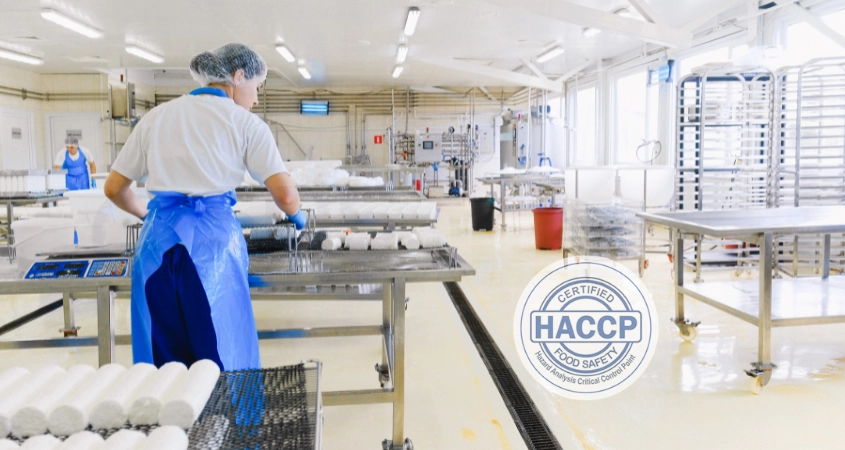
Organizations should drive continual improvement through verification activities, internal audits, customer feedback, and root cause analysis. These activities help maintain system effectiveness, minimize food safety risks, and strengthen overall operational performance.
5. HACCP Implementation Process
Every organization has different production processes, operational maturity, and food safety requirements. Therefore, SQS Global does not apply a one-size-fits-all implementation approach. Instead, we develop tailored HACCP implementation plans based on each organization’s operational conditions and production characteristics.
Our recommended implementation process consists of three key phases:
- Phase 1 – Assessment and HACCP Team Formation: Assess the current production facility, production processes, and organizational readiness while establishing the HACCP Team to develop an appropriate implementation roadmap.
- Phase 2 – HACCP Plan Development: Conduct hazard analysis, determine Critical Control Points (CCPs), and develop the HACCP Plan in accordance with the 7 HACCP Principles.
- Phase 3 – Implementation, Internal Audit, and Continual Improvement: Put the HACCP system into operation, conduct internal audits, and implement improvements before certification.
**SQS Global Recommendation
Many organizations face challenges when implementing HACCP due to limited experience in hazard analysis, CCP determination, and documentation development. Partnering with an experienced HACCP consultant from the beginning helps shorten implementation time, reduce nonconformities, and improve the likelihood of achieving certification on the first audit.
With extensive experience in HACCP consulting, training, and food safety management system implementation, SQS Global supports organizations from gap assessment and documentation development to HACCP Team training, system implementation, and certification. Our tailored solutions help organizations implement an effective HACCP system and maintain long-term compliance.