

 VIE
VIE📌 Key Takeaways
- FSSC 22000 is a Food Safety Management System Certification Scheme developed and managed by the Foundation FSSC.
- Recognized by the Global Food Safety Initiative (GFSI) since 2010, FSSC 22000 has become one of the most widely adopted food safety certification schemes across the global food supply chain.
- FSSC 22000 Version 7 is the latest edition, officially released in May 2026, introducing significant updates to the scope of application, Prerequisite Programmes (PRPs), and the Additional FSSC Requirements.
- The scheme is built upon ISO 22000, combined with sector-specific PRPs and Additional FSSC Requirements to establish a comprehensive Food Safety Management System (FSMS).
1. Definition of FSSC 22000
FSSC 22000 (Food Safety System Certification 22000) is a Food Safety Management System Certification Scheme developed and managed by the Foundation FSSC. The scheme is built upon ISO 22000, combined with sector-specific PRPs and Additional FSSC Requirements. FSSC 22000 Version 7 is the latest edition of the certification scheme.
Recognized by the Global Food Safety Initiative (GFSI) since 2010, FSSC 22000 has become one of the most widely recognized and adopted food safety certification schemes worldwide, meeting the requirements of customers, retailers, and international food supply chains.
Which sectors does FSSC 22000 apply to?
The certification scheme is designed for the entire food supply chain, covering primary production, food manufacturing, and supporting activities.
The main applicable sectors include:
- Primary Production: Agriculture, livestock farming, aquaculture, and the production of food ingredients and food components.
- Food Manufacturing and Processing: Food, beverages, food additives, food ingredients, animal feed, and pet food.
- Supporting Activities: Manufacture of food contact packaging, warehousing, storage, transportation, and logistics services within the food supply chain.

Note: Each sector is assigned to a specific Category under the FSSC 22000 Scheme and is subject to the corresponding technical requirements.
2. Versions of the FSSC 22000 Scheme
Since its first publication in 2009, FSSC 22000 has undergone 7 updates to address evolving food safety management requirements and the benchmarking requirements of the Global Food Safety Initiative (GFSI). Each version has not only expanded the scope of application but also introduced new requirements to enhance risk management effectiveness and ensure food safety throughout the food supply chain.
| Date | Version | Key Updates |
|---|---|---|
| 05/2009 | Version 1 | First published, based on ISO 22000:2005 and PAS 220:2008. |
| 02/2010 | Version 2 | Recognized by GFSI, expanding global acceptance. |
| 02/2013 | Version 3 | Expanded the scope of application and updated in line with GFSI benchmarking requirements. |
| 07/2017 | Version 4.1 | Adopted ISO/TS 22002-x PRPs and introduced updated requirements for Food Fraud Prevention and Food Defense. |
| 05/2019 | Version 5.1 | Updated in accordance with ISO 22000:2018, adopting the High-Level Structure and strengthening the risk-based management approach. |
| 04/2023 | Version 6 | Updated in accordance with the GFSI Benchmarking Requirements 2020, introducing additional requirements for Food Safety Culture, Equipment Management, and Food Loss and Waste. |
| 05/2026 | Version 7 | Updated ISO 22002-x:2025 PRPs, revised the Additional FSSC Requirements and the Certification Scheme Requirements. |
3. What Has Been Updated in FSSC 22000 Version 7?
FSSC 22000 Version 7 has been published to reflect the latest developments in food safety management and international benchmarking requirements. The new version focuses on three key areas:
- Updated in accordance with the ISO 22002-x:2025 series of PRPs, ensuring that production and operational requirements are aligned with the practical needs of each sector within the food supply chain.
- Aligned with the Global Food Safety Initiative Benchmarking Requirements 2024, helping maintain the international recognition of the FSSC 22000 Certification Scheme.
- Strengthened sustainability-related requirements, encouraging organizations to enhance environmental responsibility, improve resource efficiency, while continuing to meet food safety requirements.
3.1 [FREE DOWNLOAD] Category Classification in Version 7
One of the most significant updates introduced in Version 7 is the refinement of the Category classification system. Compared with Version 6, several sectors have been subdivided into more specific categories, enabling a more accurate determination of production activities, processing operations, and certification scope for each organization.
Key changes include:
- Category C0 (Primary Processing of Animal Products) has been divided into C0-01 (Livestock and Poultry) and C0-02 (Aquatic Animals), providing a clearer distinction between different types of primary processing activities.
- Category CIV (Processing of Ambient Stable Products) has been divided into six subcategories (CIV-1 to CIV-6) based on processing technologies, including sterilization, drying, fermentation, bakery and confectionery production, edible oils and fats, and beverages.
- Category I (Production of Food Packaging) has been divided into five subcategories (I-1 to I-5) according to packaging material types, including plastics, paper, metal, glass, and other materials.
- Category B (Primary Processing of Plant Products) now includes multi-site certification, applicable to organizations operating multiple locations for the primary processing of plant products.
>> Download the FSSC 22000 Version 7 PDF document to access the complete details of the latest updates, new requirements, and the scope of the Certification Scheme.
3.2 Effective Date and Transition Timeline to FSSC 22000 Version 7
Version 7 was officially published on 1 May 2026. Following its publication, organizations certified against Version 6 are allowed to transition to Version 7 according to the timeline established by the Foundation FSSC.
- 1 May 2026 – 30 April 2027: Organizations may continue to undergo certification audits against Version 6.
- 1 May 2027 – 30 April 2028: Organizations shall complete the transition from Version 6 to Version 7.
- After 30 April 2028: Version 6 is no longer valid. Organizations must have completed the transition to Version 7 to maintain certification.
Note: Transitioning from Version 6 to Version 7 is not limited to updating documentation. Organizations should review all new scheme requirements to ensure that their management system complies with the applicable certification scope and audit requirements.
To ensure a timely and effective transition to FSSC 22000 Version 7, organizations should proactively review their existing management system, develop a transition plan, and consult with qualified consultants or their certification body to determine the most appropriate transition approach.
4. Components of the FSSC 22000 Certification Scheme
Although FSSC 22000 has undergone seven revisions, the certification scheme continues to be built on 3 core components ISO 22000, Prerequisite Programmes (PRPs), and the Additional FSSC Requirements. In Version 7, this structure remains unchanged; however, the content of each component has been updated to align with the latest scheme requirements.
4.1 ISO 22000 – Food Safety Management System
ISO 22000 is the international standard that specifies the requirements for a FSMS and serves as the foundation of the FSSC 22000 Certification Scheme. The standard focuses on controlling food safety hazards through risk assessment, the application of HACCP principles, food chain communication, and the continual improvement of the management system.
In addition, ISO 22000 follows the High-Level Structure (HLS), making it compatible with other management system standards such as ISO 9001 and ISO 14001. This enables organizations to integrate multiple management systems into a single framework, simplifying the development, implementation, and maintenance of management system documentation.
4.2 PRPs – Prerequisite Programmes
PRPs are a set of basic conditions and operational activities designed to establish and maintain a suitable production environment, thereby helping to prevent food safety hazards. They cover requirements related to infrastructure, facility layout, sanitation, pest control, equipment maintenance, storage, transportation, and other production conditions.
In FSSC 22000 Version 7, the PRP requirements have been updated in accordance with the ISO 22002 standards applicable to each sector of the food supply chain, replacing the previous ISO/TS 22002 series. In addition, ISO 22002-100:2025 has been introduced as the foundation standard, contributing to greater consistency and harmonization across the PRP standards for different sectors.
4.3 Additional FSSC Requirements
The Additional FSSC Requirements are established by the Foundation FSSC to strengthen the certification scheme and ensure compliance with the recognition criteria of the GFSI. These requirements focus on areas such as Food Safety Culture, Food Defense, Food Fraud Prevention, Allergen Management, Environmental Monitoring, and other management requirements updated in each version of the scheme.
5. Key Requirements of FSSC 22000 Version 7
The key requirements include:
- Food Safety Culture: Organizations shall establish and maintain a food safety culture through leadership commitment, employee awareness, internal communication, and periodic evaluation of its effectiveness.
- Food Fraud Prevention: Establish procedures to identify, assess, and control food fraud risks associated with raw materials, products, and the supply chain in order to minimize risks that may affect food safety.
- Food Defense: Identify intentional threats to products, manufacturing processes, and production facilities, and establish appropriate preventive and response measures.

- Allergen Management: Control allergens throughout the processes of raw material receipt, production, storage, and labeling to minimize the risk of cross-contamination.
- Environmental Monitoring: Establish an environmental monitoring programme, where applicable, to control microbiological contamination risks and evaluate the effectiveness of sanitation activities.
- Management of Externally Provided Services and Materials: Establish criteria for the selection, evaluation, and monitoring of suppliers, raw materials, and outsourced services that may affect food safety.
- Food Loss and Waste Control: Encourage organizations to establish measures to reduce food loss during production, storage, and distribution, contributing to efficient resource utilization and sustainable development.
6. Relationship Between HACCP, ISO 22000 and FSSC 22000
All three standards share the common objective of ensuring food safety, but they differ in scope and level of requirements. They are closely related and have evolved in a progressive manner, with HACCP serving as the foundation of ISO 22000, while FSSC 22000 is built upon ISO 22000 and further expands it with additional certification scheme requirements.
The relationship between these three standards can be illustrated as follows: HACCP → ISO 22000 → FSSC 22000
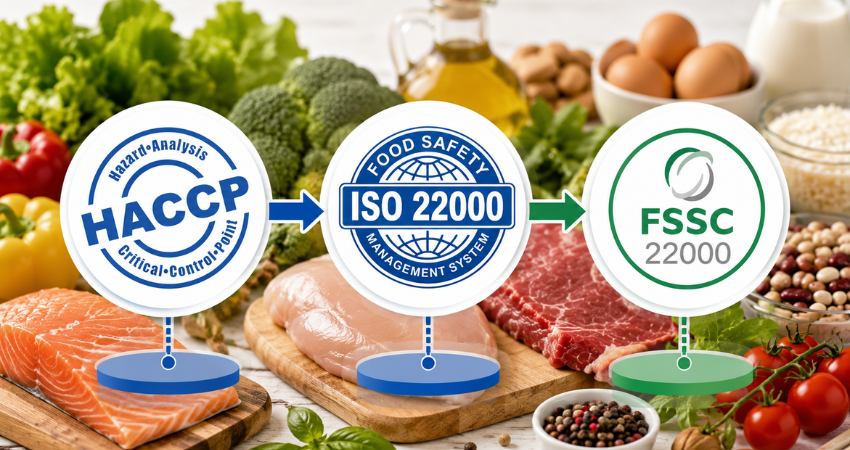
- HACCP – The Foundation of ISO 22000 and FSSC 22000
HACCP enables organizations to identify, assess, and control food safety hazards by determining Critical Control Points (CCPs) and establishing appropriate control measures throughout the production process.
- ISO 22000 – Expanding HACCP into a Food Safety Management System
In addition to hazard control, ISO 22000 introduces requirements for risk management, leadership, resource management, food chain communication, and continual improvement, enabling organizations to operate a more systematic and effective Food Safety Management System (FSMS).
- FSSC 22000 – Enhancing the ISO 22000 Management System
FSSC 22000 expands the requirements of ISO 22000 by incorporating PRPs and additional management requirements, resulting in a more comprehensive food safety management system. In addition, the certification scheme is developed in accordance with the recognition criteria of GFSI, making it a preferred choice for organizations seeking to meet the requirements of customers, business partners, and international food supply chains.
It can be seen that HACCP, ISO 22000, and FSSC 22000 are not three independent systems but are developed in a progressive and complementary manner. HACCP provides the foundation for hazard control, ISO 22000 expands it into a Food Safety Management System, and FSSC 22000 further strengthens the system by incorporating Prerequisite Programmes and Additional FSSC Requirements, while meeting the recognition criteria of the Global Food Safety Initiative.
7. Guidance on Transitioning from ISO 22000 to FSSC 22000
Organizations that have implemented ISO 22000 can transition directly to FSSC 22000 Version 7 without implementing previous versions. The transition is carried out by reviewing the existing management system and incorporating the requirements of the certification scheme.
The following aspects should be considered during the transition:
- Conduct a gap analysis between the existing ISO 22000 management system and the requirements of the latest FSSC 22000 version to identify areas requiring additional implementation or modification.
- Implement Prerequisite Programmes (PRPs) in accordance with the applicable ISO 22002 standard for the organization’s sector.
- Incorporate the Additional FSSC Requirements, including Food Safety Culture, Food Defense, Food Fraud Prevention, Allergen Management, and other management requirements specified in the current version.
- Update the management system documentation and records to ensure compliance with the requirements of FSSC 22000 before the certification audit.
The extent of the transition depends on the organization’s scope of activities and the maturity of its existing ISO 22000 management system. For organizations that have effectively implemented ISO 22000, the transition generally requires only the incorporation of the additional requirements introduced in the latest version, rather than rebuilding the entire management system.
Recommendation: Before starting the transition, organizations should conduct a gap analysis to identify all additional requirements and establish an appropriate transition plan. This helps shorten the implementation timeline, minimize issues during the certification process, and improve the effectiveness of implementing the certification scheme.
8. FAQ – Frequently Asked Questions About FSSC 22000
ISO 22000 provides the foundation for a FSMS, while FSSC 22000 is built upon ISO 22000 and incorporates sector-specific PRPs together with additional management requirements. For many organizations, particularly those involved in the food supply chain or food exports, FSSC 22000 is a common requirement imposed by customers and business partners.
Yes. Organizations implementing FSSC 22000 for the first time are not required to implement or obtain certification against Version 6 before adopting Version 7. They may implement Version 7 directly and undergo certification in accordance with the current version.
Organizations already certified to Version 6 are required to transition to Version 7 in accordance with the timeline established by the Foundation FSSC in order to maintain the validity of their certification.
ISO 22000 is an international standard that specifies the requirements for a FSMS. FSSC 22000 builds upon ISO 22000 by incorporating sector-specific PRPs and the additional requirements of the certification scheme, resulting in a more comprehensive food safety management system that meets the recognition criteria of GFSI.
No. Organizations do not need to implement all three systems simultaneously. FSSC 22000 is built upon ISO 22000, and ISO 22000 already incorporates the principles of HACCP. The choice of which system to implement depends on the organization’s objectives, scope of operations, and the requirements of its customers or target markets.
** Conclusion
FSSC 22000 is one of the most widely recognized food safety certification schemes worldwide and is adopted by many organizations to meet the requirements of the global food supply chain. With Version 7 now serving as the current version of the certification scheme, organizations should fully understand and implement the latest updates to its requirements and scope of application to ensure continued compliance with the scheme, meet the recognition criteria of the Global Food Safety Initiative (GFSI), and satisfy evolving market requirements.