

 VIE
VIE📌 Key Takeaways
- ISO 22000 is an international standard for Food Safety Management Systems (FSMS), applicable to all organizations in the food chain, from production and processing to distribution and supporting services.
- ISO 22000:2018 is the current version of the standard. It is based on the High-Level Structure (HLS) comprising 10 clauses and was supplemented with an amendment on climate change in 2024.
- The standard is built on four core elements: interactive communication, system management, PRPs and HACCP, helping organizations identify and control food safety hazards.
- Implementing ISO 22000 helps organizations improve management capability, meet regulatory and customer requirements, and enhance credibility in the supply chain and international markets.
1. What is ISO 22000?
ISO 22000 is an international standard that specifies the requirements for a Food Safety Management System (FSMS), published by the International Organization for Standardization (ISO). The standard enables organizations throughout the food chain to establish, implement, maintain and continually improve a management system for identifying, controlling and preventing food safety hazards across the entire food supply chain.
Thanks to its compatibility with other management systems and its applicability to all organizations within the food chain, ISO 22000 is widely adopted in many countries and has become one of the most widely recognized standards for food safety management.
2. Mục tiêu cốt lõi của tiêu chuẩn ISO 22000
The standard is designed to help organizations throughout the food chain establish, implement, maintain and continually improve a Food Safety Management System (FSMS) using a consistent management approach. Through its requirements, ISO 22000 aims to achieve the following objectives:
- Establish a Food Safety Management System (FSMS) to provide a structured and consistently implemented management system.
- Control food safety hazards by identifying, evaluating and applying appropriate control measures for biological, chemical and physical hazards.
- Ensure the supply of safe food by maintaining effective control throughout production, processing, storage and distribution.
- Meet applicable regulatory and food safety requirements, while addressing the expectations of customers and other relevant interested parties.
- Enhance the confidence of customers and business partners through the implementation and maintenance of a Food Safety Management System based on an internationally recognized standard.
3. Versions of ISO 22000 and the Relationship with TCVN ISO 22000
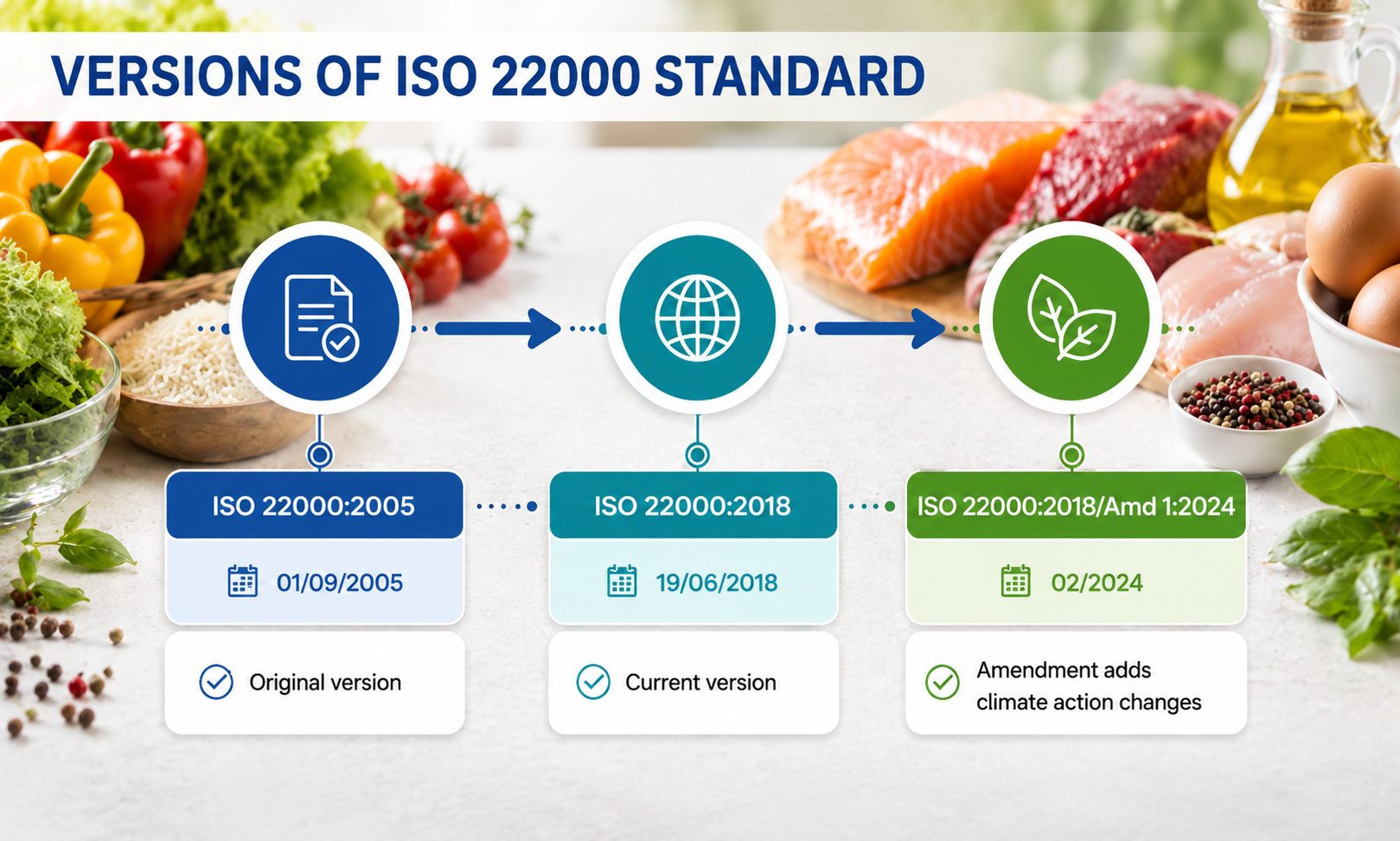
Since its first publication in 2005, the standard has undergone one major revision in 2018 and one amendment in 2024. These updates were introduced to refine the standard’s requirements, align with the management system standards framework, and address changes in the field of food safety management.
3.1 Versions of the ISO 22000 Standard
ISO 22000:2005
ISO 22000:2005 was published by the International Organization for Standardization on 1 September 2005. It was the first edition of the standard specifying the requirements for a Food Safety Management System, combining the HACCP principles of the Codex Alimentarius with a management system approach.
The standard established a unified framework for organizations throughout the food chain to establish, implement and maintain a management system for controlling food safety hazards.
In 2018, this edition was completely replaced by ISO 22000:2018.
ISO 22000:2018 (Current Version)
ISO 22000:2018 was published on 19 June 2018 and is currently the version applied worldwide. Compared with the 2005 edition, it introduced several significant changes, including:
- The adoption of the High-Level Structure (HLS), providing consistency with other management system standards such as ISO 9001 and ISO 14001, making the integration of multiple management systems more effective.
- The application of risk-based thinking at two levels, covering risks and opportunities within the management system while maintaining the HACCP hazard analysis approach during operational activities.
- A clearer distinction between PRPs, OPRPs, and CCPs, helping organizations select and apply appropriate control measures for different types of food safety hazards.
ISO 22000:2018/Amd 1:2024
In February 2024, ISO published ISO 22000:2018/Amd 1:2024, an amendment introducing requirements related to climate change to align with the common approach adopted across ISO management system standards.
The amendment introduces two key additions:
- Clause 4.1: When determining the context of the organization, consideration shall be given to whether climate change is a relevant issue for the FSMS.
- Clause 4.2: When determining the needs and expectations of interested parties, relevant climate change requirements shall be considered, where applicable.
This amendment does not change the structure, scope, or core requirements of ISO 22000:2018. Instead, it introduces additional considerations to improve the management system’s ability to respond to external environmental factors.
Changes in regulatory requirements and standard requirements may make it difficult for organizations to keep their management systems up to date. Therefore, working with a competent ISO 22000 consulting provider can help organizations implement the standard correctly, develop the required documented information, and prepare for certification audits.
3.2 Relationship Between ISO 22000 and TCVN ISO 22000
TCVN ISO 22000 is the Vietnamese National Standard, developed through the identical adoption of ISO 22000 published by the International Organization for Standardization. The standard specifies the requirements for a FSMS and is applicable to organizations involved in the food chain.
Currently, TCVN ISO 22000:2018 is technically equivalent to ISO 22000:2018, with identical technical content and requirements. The main difference lies in the issuing authority and the scope of publication:
- ISO 22000 is published by the International Organization for Standardization (ISO) and is applied internationally.
- TCVN ISO 22000 is published by the Ministry of Science and Technology of Vietnam as part of the Vietnamese National Standards system.
For organizations in Vietnam, implementing TCVN ISO 22000:2018 is equivalent to implementing the requirements of ISO 22000:2018.
3.3 Download Free ISO 22000 Resources
To support organizations in understanding and implementing a Food Safety Management System in accordance with ISO 22000, SQS Global has compiled a collection of reference materials, including the standard, guidance documents, and related templates. These resources provide additional information to assist organizations in studying, developing, and continually improving their management systems.
==> DOWNLOAD FREE ISO 22000 RESOURCES
4. What Is ISO 22000 Based On?
ISO 22000 is built on four core elements, each serving a different role in establishing and maintaining a Food Safety Management System.
4.1 Interactive Communication
ISO 22000 requires organizations to establish communication processes with interested parties, including suppliers, customers, regulatory authorities, and among internal functions. Effective communication ensures that food safety requirements, changes in production processes, and identified food safety hazards are communicated appropriately, providing the basis for consistent implementation of control activities.
4.2 System Management
ISO 22000 adopts a management system approach, in which food safety activities are established as part of a unified management system rather than being controlled as separate activities. The standard requires organizations to define responsibilities, processes, resources, and evaluation methods to ensure the system is operated consistently and is regularly reviewed and continually improved.
4.3 Prerequisite Programmes (PRPs)
PRPs are the basic conditions and activities that need to be established and maintained to provide a suitable environment for the production, processing, storage, and provision of safe food.
Commonly applied prerequisite programmes include:
- GMP – Good Manufacturing Practices.
- GHP – Good Hygiene Practices.
- GAP – Good Agricultural Practices.
- GDP – Good Distribution Practices.
- GTP – Good Trading Practices.
- GVP – Good Veterinary Practices.
4.4 HACCP Principles
HACCP is a preventive approach used to identify, evaluate, and control significant food safety hazards. Within ISO 22000, the HACCP principles are integrated into the management system to help organizations control hazards during the production process rather than relying solely on the inspection of finished products.
According to the Codex Alimentarius, HACCP consists of 7 principles:
- Conduct a hazard analysis.
- Determine the Critical Control Points (CCPs).
- Establish critical limits.
- Establish procedures for monitoring CCPs.
- Establish corrective actions.
- Establish verification procedures.
- Establish documentation and record-keeping.
5. Structure of the ISO 22000 Standard
ISO 22000 is based on the High-Level Structure, which consists of 10 clauses. Clauses 1 to 3 provide general information on the scope, normative references, terms and definitions, while Clauses 4 to 10 specify the requirements that organizations need to fulfil when establishing, implementing, and maintaining a FSMS.
| Clause | Description |
| 1. Scope | Defines the scope of the standard and its applicability. It is applicable to all organizations in the food chain, regardless of their size, type, or position within the food chain. |
| 2. Normative References | Lists the normative references cited in the standard. For ISO 22000:2018, this clause contains no normative references. |
| 3. Terms and Definitions | Specifies the terms and definitions used consistently throughout the standard, helping organizations understand and correctly apply the requirements of the Food Safety Management System. |
| 4. Context of the Organization | Requires the organization to determine the internal and external issues, as well as the needs of interested parties, that may affect the Food Safety Management System. The organization is also required to determine the scope of the system and establish the processes necessary for its operation. |
| 5. Leadership | Specifies the responsibilities of top management for establishing and maintaining the system. Top management is required to demonstrate commitment to food safety, establish a policy, assign responsibilities, and ensure the resources necessary for the effective implementation of the system. |
| 6. Planning | Requires the organization to determine the risks and opportunities that may affect the system, establish food safety objectives, and plan actions to achieve those objectives. This clause also addresses the management of changes that may affect the management system. |
| 7. Support | Specifies the resources required to operate the system, including competence, awareness, communication, infrastructure, the work environment, and the control of documented information. |
| 8. Operation | This is the core clause of ISO 22000, specifying the requirements for food safety control activities. It covers operational planning and control, Prerequisite Programmes (PRPs), the traceability system, emergency preparedness and response, hazard analysis, hazard control planning, validation of control measure combinations, and the control of nonconforming products and processes. |
| 9. Performance Evaluation | Requires the organization to monitor, measure, analyse, and evaluate the performance of the management system. This clause covers internal audits, management review, and evaluation activities to determine the extent to which the requirements of the standard have been fulfilled. |
| 10. Improvement | Specifies the requirements for handling nonconformities, taking corrective actions, and continually improving the Food Safety Management System. The objective is to maintain the suitability of the system and enhance its ability to meet food safety requirements during operation. |
6. Requirements for Implementing a Food Safety Management System in Accordance with ISO 22000
To effectively implement a FSMS in accordance with ISO 22000, an organization needs to establish the necessary management, resource, and operational conditions. The key requirements include:
- Understanding the requirements of ISO 22000 to determine the scope of application, the implementation approach, and the method for establishing a Food Safety Management System appropriate to the organization’s activities.
- Obtaining top management commitment to provide direction, allocate resources, and promote the establishment, maintenance, and continual improvement of the Food Safety Management System.
- Establishing and maintaining Prerequisite Programmes (PRPs) to provide the foundation for controlling hygiene conditions, the production environment, and other factors affecting food safety.
- Establishing a Food Safety Team with members having appropriate competence to implement, operate, and continually improve the system.
- Ensuring adequate resources, including personnel, financial resources, equipment, and supporting resources, to meet the requirements for implementing and maintaining the system.
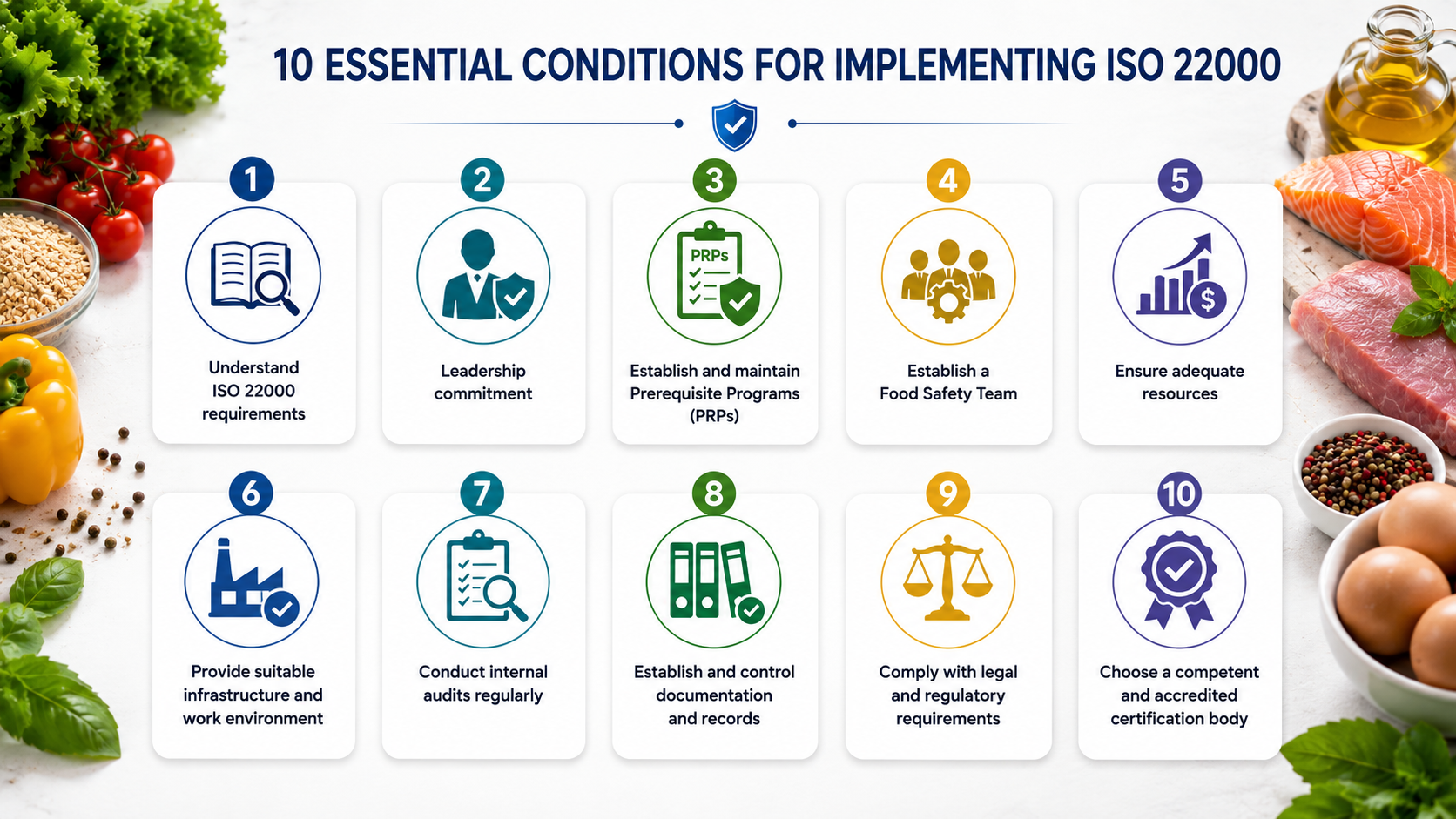
- Providing appropriate infrastructure and a suitable work environment for food production, processing, or business operations to ensure effective food safety control.
- Conducting periodic internal audits to verify the conformity of the system, identify nonconformities, and implement corrective and improvement activities.
- Establishing and controlling documented information in accordance with the requirements of ISO 22000 to ensure consistency, transparency, and information traceability.
- Complying with applicable regulatory requirements and other relevant food safety requirements throughout the establishment, implementation, and operation of the system.
- Selecting a competent and accredited certification body to conduct the certification audit and issue certification in accordance with the applicable requirements.
7. FAQ – Frequently Asked Questions About ISO 22000
No. ISO 22000 is a voluntary standard. Under the current legislation of Vietnam, organizations operating in the food sector are not required to implement ISO 22000.
However, implementing and obtaining certification to ISO 22000 helps organizations enhance their food safety management capability and meet the requirements of many customers, business partners, and export markets.
In addition, pursuant to Point k, Clause 1, Article 12 of Decree No. 15/2018/ND-CP, establishments that have been certified to ISO 22000 are exempt from obtaining the Certificate of Eligibility for Food Safety
Yes. Pursuant to Point k, Clause 1, Article 12 of Decree No. 15/2018/ND-CP, establishments holding a valid ISO 22000 certification are exempt from applying for the Certificate of Eligibility for Food Safety.
However, the establishment is still required to maintain the food safety conditions prescribed by law and fulfil the relevant obligations to the competent regulatory authorities in accordance with the applicable regulations.
ISO 22000 is applicable to all organizations involved in the food chain, regardless of their size or type of activity. Applicable organizations include food production, processing, storage, transportation, and distribution organizations; suppliers of raw materials and food contact packaging; providers of cleaning and logistics services; and other organizations related to the food chain.
An ISO 22000 certificate issued by a certification body is typically valid for 03 years. During the validity period, the organization is subject to periodic surveillance audits to confirm that the management system is maintained and continues to conform to the requirements of the standard.
In theory, an organization can implement ISO 22000 on its own if it has personnel who understand the standard and sufficient resources for implementation.
However, in practice, establishing the system often requires considerable time to understand the requirements, develop the necessary documented information, and implement the system consistently throughout the organization.
For organizations with no prior experience, using consulting services can help shorten the implementation time, reduce errors, and better prepare for the certification audit.
** Conclusion
To achieve effective implementation of ISO 22000, organizations need to establish a Food Safety Management System (FSMS) that is appropriate to their size, business sector, and specific food safety hazards. With experience in food safety consulting and training, SQS Global supports organizations in implementing the system in accordance with the requirements of the standard, from conducting a gap assessment, developing documented information, and training personnel to preparing for the certification audit.