ISO 22000 Consulting & Certification Services

✓ Certification records can be verified through the international verification platform IAFCERTSEARCH.ORG

✓ ISO 22000 certificates are assessed and issued by SQS Global in accordance with international standards, accredited through BoA and IAF recognition

✓ Experienced experts provide consulting, training, and hands-on implementation support

✓ Fully meets tender requirements and supports participation in global supply chains, food distribution, and export activities

✓ Comprehensive control of food safety hazards throughout production, processing, storage, and distribution

✓ Helps organizations standardize management systems, improve operational efficiency, and strengthen internal quality control

✓ Suitable for food manufacturers, F&B businesses, cold storage facilities, logistics providers, and organizations within the food supply chain


Chứng nhận iso 22000 cho hộ kinh doanh
SQS Global
Chứng nhận iso 22000 cho công ty thực phẩm

ISO 22000 Assessment & Certification – SQS Global

✓ Certification is listed on the international verification platform IAFCERTSEARCH.ORG

✓ ISO 22000 certificates are assessed and issued by SQS Global in accordance with international standards, accredited through BoA and IAF recognition

✓ Experienced experts provide consulting, training, and hands-on implementation support

✓ Fully meets tender requirements and supports participation in global supply chains, food distribution, and export activities

✓ Comprehensive control of food safety hazards throughout production, processing, storage, and distribution

✓ Helps organizations standardize management systems, improve operational efficiency, and strengthen internal quality control

✓ Suitable for food manufacturers, F&B businesses, cold storage facilities, logistics providers, and organizations within the food supply chain

Chứng nhận iso 22000 cho hộ kinh doanh
SQS Global
Chứng nhận iso 22000 cho công ty thực phẩm

ISO 22000:2018 Food Safety Management System

ISO 22000:2018 is an international standard that specifies the requirements for a Food Safety Management System (FSMS) and serves as the basis for ISO 22000 certification. The standard outlines what organizations need to do to demonstrate their ability to control food safety hazards and ensure the safety of food products throughout the entire food supply chain, from farm to fork. This management system can be applied to any organization involved in the food chain, regardless of its size, type, or location.

The ISO 22000 Food Safety Management System is built on the following key elements:

  • Interactive communication throughout the food supply chain
  • System management
  • Prerequisite Programs (PRPs)
  • Hazard Analysis and Critical Control Point (HACCP) principles

ISO 22000:2018 Food Safety Management System

ISO 22000:2018 is an international standard that specifies the requirements for a Food Safety Management System (FSMS) and serves as the basis for ISO 22000 certification. The standard outlines what organizations need to do to demonstrate their ability to control food safety hazards and ensure the safety of food products throughout the entire food supply chain, from farm to fork. This management system can be applied to any organization involved in the food chain, regardless of its size, type, or location.

The ISO 22000 Food Safety Management System is built on the following key elements:

  • Interactive communication throughout the food supply chain

  • System management
  • Prerequisite Programs (PRPs)
  • Hazard Analysis and Critical Control Point (HACCP) principles

Who needs ISO 22000 certification?

Most organizations involved in the food industry can benefit from obtaining ISO 22000:2018 certification, including businesses engaged in food production, processing, packaging, storage, and distribution. Typical examples include:

  • Agricultural, livestock, aquaculture, and farming enterprises
  • Food, beverage, frozen food, and packaging manufacturers
  • Producers of food additives and food-contact packaging materials
  • Restaurants, industrial kitchens, catering services, and F&B chains
  • Cold storage, logistics, transportation, and food distribution companies
  • Organizations seeking to export products or participate in the supply chains of retailers, supermarkets, and major brands

**Under Vietnamese regulations, organizations that have implemented and obtained ISO 22000 or HACCP certification may be exempt from obtaining a Food Safety Eligibility Certificate, subject to applicable legal requirements.

Hầu hết doanh nghiệp trong chuỗi cung ứng thực phẩm đều cần áp dụng ISO 22000.

What should organizations prepare for ISO 22000 certification?

To achieve ISO 22000 certification, organizations must establish a Food Safety Management System (FSMS) that complies with international requirements. This includes preparing the necessary documentation, implementing food safety controls, and ensuring effective management of food safety risks across operations.

Hồ sơ & tài liệu đánh giá chứng nhận ISO 22000:2018
Cơ sở vật chất trong nhà máy thực phẩm

Documentation & Records

  • Food safety policy, objectives, and Standard Operating Procedures (SOPs)
  • Quality control, hazard control, and traceability records
  • Food hygiene and sanitation records, pest control records, and temperature monitoring logs
  • Employee training records and competency evaluation related to ISO 22000 requirements
  • Legal and regulatory documents required for food production and business operations

Facilities & Personnel Readiness

Organizations should ensure that production facilities, processing areas, and equipment are properly designed and maintained to prevent cross-contamination and comply with food safety requirements.

In addition, personnel responsible for quality and food safety management should understand their roles, operational procedures, and the requirements of the ISO 22000 system to effectively support the certification audit process.

Internal Audit & Corrective Actions

Before applying for certification, organizations should conduct an internal audit to evaluate the effectiveness and compliance of their ISO 22000 Food Safety Management System.

Any identified nonconformities should be addressed promptly to reduce audit risks, ensure compliance with certification requirements, and support the effective operation of the system in practice.

What should organizations prepare for ISO 22000 certification?

To achieve ISO 22000 certification, organizations must establish a Food Safety Management System (FSMS) that complies with international requirements. This includes preparing the necessary documentation, implementing food safety controls, and ensuring effective management of food safety risks across operations.

Documentation & Records

  • Food safety policy, objectives, and Standard Operating Procedures (SOPs)
  • Quality control, hazard control, and traceability records
  • Food hygiene and sanitation records, pest control records, and temperature monitoring logs
  • Employee training records and competency evaluation related to ISO 22000 requirements
  • Legal and regulatory documents required for food production and business operations
Hồ sơ & tài liệu đánh giá chứng nhận ISO 22000:2018

Facilities & Personnel Readiness

Organizations should ensure that production facilities, processing areas, and equipment are properly designed and maintained to prevent cross-contamination and comply with food safety requirements.

In addition, personnel responsible for quality and food safety management should understand their roles, operational procedures, and the requirements of the ISO 22000 system to effectively support the certification audit process.

Cơ sở vật chất trong nhà máy thực phẩm

Internal Audit & Corrective Actions

Before applying for certification, organizations should conduct an internal audit to evaluate the effectiveness and compliance of their ISO 22000 Food Safety Management System.

Any identified nonconformities should be addressed promptly to reduce audit risks, ensure compliance with certification requirements, and support the effective operation of the system in practice.

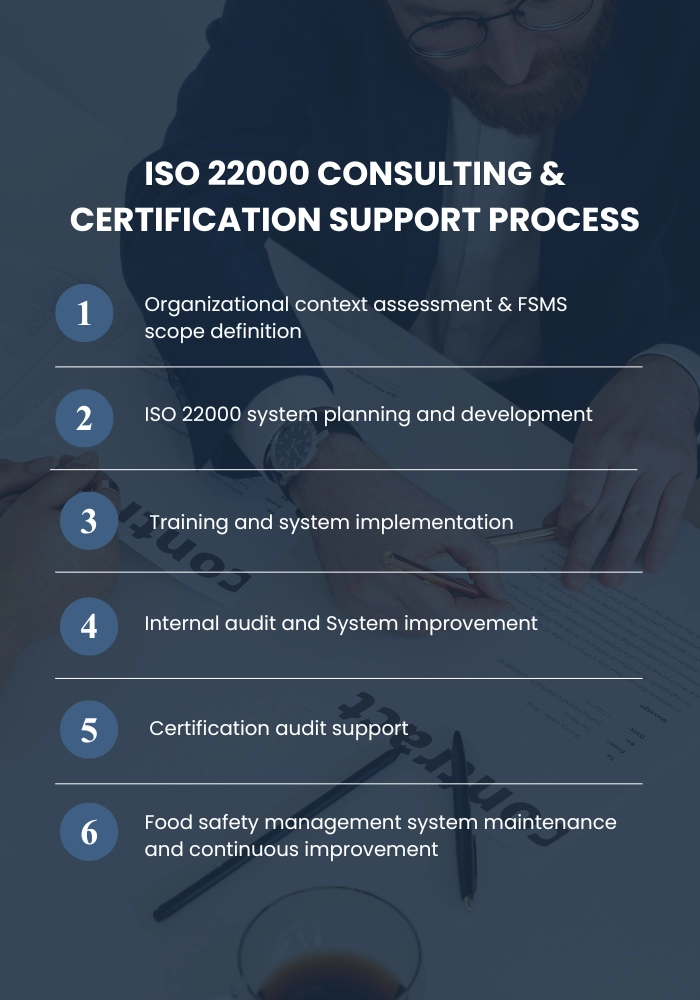
ISO 22000 Consulting & Certification Process at SQS Global

In practice, many organizations face challenges when implementing ISO 22000 due to limited experience in developing a Food Safety Management System, incomplete documentation, or a lack of understanding of certification requirements. These challenges can lead to delays, increased costs, and a lower likelihood of achieving certification on the first audit.

As a trusted ISO 22000 certification body, SQS Global has supported numerous organizations across the food industry. We provide end-to-end support, including system development, documentation preparation, personnel training, implementation guidance, audit readiness, and certification assessment.

With an experienced team of experts and a structured certification process, SQS Global helps organizations streamline implementation, optimize costs, and strengthen food safety management in accordance with ISO 22000 requirements.

SQS Global conducts an initial assessment to evaluate:

  • Business operations and activities
  • Food production and supply chain processes
  • Applicable legal and regulatory requirements
  • Customer expectations and target market requirements
  • The organization’s current level of compliance with ISO 22000 requirements

Based on the assessment results, the scope of the Food Safety Management System (FSMS) and the implementation roadmap will be defined to ensure an effective and practical certification process.

Organizations are guided in establishing:

  • Food safety policy and objectives
  • Prerequisite Programs (PRPs)
  • HACCP plan
  • Operational control procedures
  • Risk and opportunity management processes
  • Documented information and management system documentation in accordance with ISO 22000:2018 requirements

The system is developed to align with the organization’s actual operations, ensuring effective implementation and readiness for certification assessment.

SQS Global provides ISO 22000 awareness and implementation training for relevant personnel and supports the organization in applying the Food Safety Management System (FSMS) in daily operations.

During this stage, the organization is guided in controlling production processes, establishing operational control measures, managing CCPs and OPRPs, maintaining operational records, and strengthening communication throughout the food supply chain to ensure the effective and consistent implementation of the FSMS.

Following the implementation period, SQS Global conducts:

  • Internal audits
  • Compliance reviews
  • Evaluation of control effectiveness
  • Support for addressing nonconformities

The objective of this stage is to ensure that the Food Safety Management System operates effectively and is fully prepared for the certification audit.

SQS Global conducts a certification audit of the organization’s Food Safety Management System (FSMS) in accordance with ISO 22000:2018 requirements.

Upon successful completion of the audit and fulfillment of all certification requirements, the organization will be awarded an ISO 22000 certificate by SQS Global.

After certification, organizations are required to maintain internal audits, operational controls, and continual improvement activities to ensure the ongoing effectiveness of the Food Safety Management System and compliance with periodic surveillance audits.

**Note:

The ISO 22000 certificate is valid for three (3) years from the date of issue. During this period, organizations must maintain and operate their Food Safety Management System in accordance with ISO 22000 requirements.

At the end of the certification cycle, organizations must undergo a recertification audit to renew their ISO 22000 certification and maintain its validity.

ISO 22000 consulting & certification process

With SQS Global’s ISO 22000 certification services, organizations benefit from expert guidance on compliance requirements, certification procedures, and recertification planning, helping save time, reduce costs, and minimize certification risks.

Sample ISO 22000 Certificate Issued

This is a sample ISO 22000 Certificate issued by SQS Global to organizations that have successfully completed the certification process and demonstrated compliance with the requirements of the ISO 22000 Food Safety Management System.

The certificate confirms that the organization has established and effectively implemented a food safety management system in accordance with the international ISO 22000 standard, helping enhance food safety performance, strengthen customer confidence, and improve competitiveness in both domestic and international markets.

Get Started Today – Enjoy 10% Off
ISO 22000 certificate SQS Global

SQS Global – A Leading ISO 22000 Certification and Food Safety Assurance Body

SQS Global is a reputable certification and consulting organization specializing in Food Safety Management Systems (FSMS) and internationally recognized food safety standards. We provide comprehensive support throughout the ISO 22000 implementation, certification, and continual improvement lifecycle, enabling organizations to demonstrate conformity with globally accepted food safety requirements and regulatory obligations.

With extensive expertise across the food manufacturing, beverage processing, seafood, catering, logistics, warehousing, and food supply chain sectors, SQS Global delivers industry-specific solutions designed to strengthen food safety governance, operational control, regulatory compliance, and market competitiveness.

Why choose SQS Global

Organizations choose SQS Global for:

  • Extensive experience across food manufacturing, F&B, cold storage, and food supply chains
  • Efficient implementation support to improve certification readiness and first-time audit success
  • Dedicated guidance throughout the certification process, including nonconformity resolution
  • Practical consulting tailored to actual business operations
  • Ongoing support for maintaining and improving ISO 22000 management systems
  • Clear processes, responsive support, and cost-effective solutions
  • Assistance in meeting customer, retailer, and export market requirements
  • Customized implementation roadmaps based on business size, industry, and operational needs
Tổ chức cấp chứng nhận ISO 22000:2018 SQS Global

FAQ – Frequently Asked Questions About ISO 22000 Certification

The cost of ISO 22000 certification depends on several factors, including the size of the organization, the scope of certification, the maturity of the Food Safety Management System, and the certification body selected.

For a detailed quotation tailored to your specific requirements, please contact SQS Global for consultation and assessment.

The implementation and certification process typically takes between 1 and 3 months, depending on the size of the organization, the current status of the management system, and the readiness of the required documentation.

Organizations that have already implemented HACCP or other management systems may achieve certification within a shorter timeframe.

Yes. An ISO 22000 certificate may be suspended or withdrawn if an organization fails to maintain the effectiveness of its Food Safety Management System, does not comply with certification requirements, or fails to address nonconformities identified during surveillance or recertification audits.

Additionally, significant food safety incidents, repeated noncompliance, or the discontinuation of the management system may impact the validity of the certification.

Yes. ISO 22000 is designed to be applicable to organizations of all sizes across the food supply chain, including small and medium-sized enterprises (SMEs), family-owned businesses, food processors, distributors, and large-scale manufacturers.

For smaller organizations, ISO 22000 certification can strengthen brand reputation, enhance customer confidence, improve food safety performance, and support access to new markets and business opportunities.

The annual cost of maintaining ISO 22000 certification depends on factors such as the size of the organization, the number of operational sites, the certification scope, and the surveillance audit requirements established by the certification body.

To maintain certification, organizations are generally required to undergo annual surveillance audits. Additional costs may include system maintenance, employee training, internal audits, and continual improvement initiatives to ensure ongoing compliance and effectiveness.

When choosing an ISO 22000 certification body, organizations should evaluate the following key criteria:

  • Accreditation by a recognized and reputable accreditation body
  • Qualified and experienced auditors with expertise in food safety and the relevant industry sector
  • Transparent, impartial, and professionally managed audit processes
  • International recognition and acceptance of certificates for commercial, regulatory, and export purposes
  • Proven experience across different segments of the food supply chain

  • Ongoing technical support and clear communication throughout the certification lifecycle

Selecting a reputable certification body helps ensure the credibility, recognition, and long-term value of an organization’s ISO 22000 certification.

Other Certification Services Offered by SQS Global

Pharmaceutical & Cosmetics Industry

ISO 13485

ISO 13485 Certification

Other Certification Services Offered by SQS Global

Pharmaceutical & Cosmetics Industry

ISO 13485

ISO 13485 Certification