
 VIE
📌 Quick Summary
- GMP is a system of good manufacturing practices applied across various industries where product quality and safety require strict control.
- Depending on product characteristics, regulatory requirements, and target markets, each industry may follow specific GMP guidelines, such as WHO-GMP, EU-GMP, PIC/S GMP, FDA cGMP, or ASEAN Cosmetic GMP.
- Building a GMP-compliant manufacturing facility requires an appropriate implementation plan that integrates regulatory requirements, facility design, and manufacturing operational procedures.
1. Good Manufacturing Practice
GMP (Good Manufacturing Practice) is a system of principles and requirements designed to ensure that products are consistently manufactured and meet established quality and safety standards.
GMP focuses on controlling factors throughout the manufacturing process to minimize risks. In practice, issues such as contamination, cross-contamination, deviations in product composition, incorrect content or dosage, and labeling errors can be difficult to detect through finished-product testing alone.

Good Manufacturing Practice principles are widely applied in the pharmaceutical, food, cosmetics, and medical device industries. Depending on product characteristics and the regulatory requirements of each sector, these principles are specified in corresponding guidelines.
Benefits of Implementing GMP
Proper implementation helps manufacturers maintain effective operational control and ensure consistent product quality:
- Product Quality Control: Minimizes deviations in composition, content, and purity while maintaining consistency between batches.
- Prevention of Operational Errors: Controls risks at each manufacturing stage, helping reduce nonconforming products and minimize raw material waste.
- Support for Traceability and Incident Management: Complete manufacturing records enable manufacturers to identify the causes of quality issues or customer complaints more efficiently.
- Compliance with Regulatory and Market Requirements: Helps manufacturers comply with applicable industry regulations and meet the standards required by business partners and target markets.
2. Basic Requirements of GMP
To comply with GMP, manufacturing facilities must meet the following key groups of requirements:
- Premises and Production Areas: Must be designed to suit the product characteristics and manufacturing processes. Functional areas should be arranged according to an appropriate one-way flow to minimize mix-ups and the risk of cross-contamination.
- Machinery and Equipment: Must be suitable for their intended purposes, properly installed, cleaned, maintained, and periodically calibrated to ensure reliable operation.
- Incoming Materials: Must be inspected, clearly identified, and stored under specified conditions. Effective control at this stage helps prevent mix-ups, contamination, and deterioration in material quality.
- Personnel: Must receive training appropriate to their job responsibilities, comply with personal hygiene requirements, and wear protective clothing suitable for the classification of each area.
- Manufacturing Processes: All operations must be performed in accordance with established Standard Operating Procedures (SOPs). Technical parameters that may affect product quality must be monitored and properly recorded.
- Sanitation and Environmental Control: Premises, equipment, and utensils must be maintained in a clean condition. Environmental parameters such as temperature, humidity, differential pressure, and air quality must be controlled whenever they directly affect the product.
- Quality Control (QC): Raw materials, intermediate products, and finished products must be sampled and tested against specified criteria to determine their compliance before proceeding to the next manufacturing stage or being released.
- Documentation and Records: All manufacturing, testing, cleaning, and maintenance activities must be accurately recorded and systematically retained to support monitoring and traceability when required.
3. Notable GMP Updates in 2026
International Good Manufacturing Practice guidelines (WHO, EU, PIC/S, FDA, etc.) are regularly reviewed and updated in response to developments in manufacturing practices. In 2026, manufacturers should pay attention to six key areas:
| Update Area | Implementation and Impact |
|---|---|
| Digitalization and Data Integrity | Applying electronic records and Electronic Quality Management Systems (eQMS) to manage and store data while ensuring accuracy and transparency. |
| Enhanced Traceability | Managing information throughout the process, from incoming raw materials to finished products, to facilitate investigation and containment when incidents occur. |
| Quality Risk Management | Proactively identifying, assessing, and controlling risks that may affect product quality. |
| Manufacturing Environment Control | Strengthening environmental controls throughout production to prevent contamination and cross-contamination. |
| Personnel Competency Development | Enhancing employee training, updating technical knowledge, and assessing personnel competency. |
| Harmonization with International Guidelines | GMP guidelines continue to be reviewed and updated to improve consistency in quality management. |
4. GMP Across Different Industries
Good Manufacturing Practice is applied across various manufacturing industries; however, there is no single set of requirements that applies uniformly to all sectors. Depending on product characteristics, GMP focuses on controlling factors that may directly affect product quality and safety during use.
GMP in the Food Industry
The major hazards in food manufacturing include contamination by microorganisms, chemicals, or foreign matter originating from raw materials, equipment, the production environment, and personnel handling. Therefore, GMP in food manufacturing focuses on facility hygiene, raw material quality, prevention of cross-contamination, and appropriate processing and storage conditions.
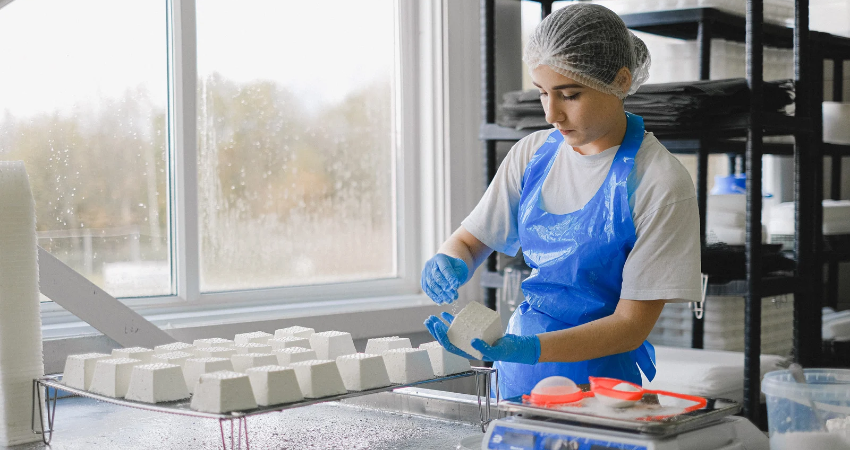
Food hygiene principles are addressed in Codex CXC 1-1969, which includes Good Hygiene Practices (GHP) and the Hazard Analysis and Critical Control Point (HACCP) system. In Vietnam, manufacturers of health supplement products must comply with GMP requirements under applicable regulations. Manufacturers of conventional food products must comply with the corresponding food safety regulations.
GMP in the Pharmaceutical Industry
For pharmaceutical products, even minor deviations in active ingredient content, composition, or purity can directly affect therapeutic efficacy and patient safety. In addition, manufacturing multiple product lines using the same equipment may present a significant risk of cross-contamination.
Therefore, pharmaceutical GMP strictly controls formulation accuracy, batch-to-batch consistency, and manufacturing environmental conditions, particularly sterile manufacturing requirements for products such as injections and eye drops. Commonly applied guidelines include WHO-GMP, EU-GMP, PIC/S GMP, and cGMP under the regulations of the U.S. Food and Drug Administration (FDA).
GMP in the Cosmetics Industry
Cosmetic products must maintain the stability of their declared characteristics, such as color, fragrance, texture, and uniformity, throughout their shelf life. Changes in water quality, mixing ratios, or storage conditions may affect product quality.
In cosmetic manufacturing, GMP focuses on raw material quality, formulation and packaging conditions, microbiological contamination control, and compatibility between the product and its packaging. Two representative guidelines in this field are ASEAN Cosmetic GMP and ISO 22716:2007.
5. Process for Building a GMP-Compliant Manufacturing Facility
Building a GMP-compliant manufacturing facility requires an integrated approach, beginning with the selection of applicable standards and facility layout design, followed by construction, equipment installation, and the establishment of a manufacturing management system. The implementation process generally consists of the following steps:
- Step 1 – Identify the Products and Applicable GMP Standards: Determine the product types, manufacturing sector, and target markets to select the appropriate GMP framework.
- Step 2 – Plan and Design the Manufacturing Facility: Allocate areas for raw material receipt, production, quality control, packaging, and storage. Arrange the movement of raw materials, personnel, and finished products to minimize intersecting flows and cross-contamination.
- Step 3 – Design and Install Technical Systems: Implement supporting systems such as HVAC, water supply, compressed air, electrical systems, and waste treatment. Technical solutions must meet the control requirements of each production area.

- Step 4 – Construct the Facility and Install Equipment: Complete the facility construction and install machinery and auxiliary systems in accordance with the approved design documentation.
- Step 5 – Establish the Operational System: Develop SOPs, manufacturing records, sanitation procedures, and quality control procedures. Provide personnel training before putting the production line into operation.
- Step 6 – Conduct Trial Operations and GMP Assessment: Check the operation of the facility, equipment, and manufacturing procedures; perform necessary qualification and validation activities, address identified nonconformities, and prepare for assessment in accordance with the applicable GMP framework.
The design and implementation of a GMP-compliant manufacturing facility require close coordination between regulatory requirements, engineering solutions, and the quality management system. SQS Global provides consulting and training services to support manufacturers in understanding GMP requirements and assessing their level of compliance in accordance with their respective manufacturing sectors.
Contact a Consulting Expert**Conclusion
Today, requirements for product quality, product safety, and international manufacturing standards are receiving increasing attention. Manufacturers should proactively understand and keep up to date with GMP regulations relevant to their operations while strengthening their production quality control capabilities. Properly understanding and implementing the applicable standards not only helps manufacturers meet regulatory requirements but also creates advantages when working with business partners and expanding into new markets.