

 VIE
VIE📌 Summary
- ISO 9001 is an international standard that specifies requirements for a Quality Management System (QMS) and is applicable to various types of organizations.
- ISO 9001:2015 is the current edition, while ISO 9001:2026 is the next revised edition, expected to be published in September 2026.
- The standard is based on seven quality management principles and consists of 10 clauses.
- ISO 9001 can be applied in conjunction with other management system standards, such as ISO 14001, ISO 45001, ISO 22000, ISO 13485, and ISO/IEC 27001, depending on the organization’s industry and specific needs.
1. What Is ISO 9001?
ISO 9001 is an international standard that specifies requirements for a Quality Management System (QMS) and is published by the International Organization for Standardization (ISO). ISO is an independent, non-governmental organization headquartered in Geneva, Switzerland, with national standards bodies from more than 160 countries as its members.
The standard provides a framework and general requirements for organizations to establish, operate, and control their quality management systems, ensuring that processes are carried out consistently and that products and services meet customer requirements and applicable requirements.
ISO 9001 does not prescribe specific methods for businesses to manufacture products or provide services. Instead, it specifies requirements for the quality management system, allowing each organization to establish and implement a system appropriate to its size, industry, and actual operations.
TCVN ISO 9001:2015 and ISO 9001:2015
TCVN ISO 9001:2015 is a Vietnamese National Standard that specifies requirements for a QMS and is equivalent to the international standard ISO 9001:2015. The standard was published in Vietnam to provide a basis for organizations and businesses to establish, maintain, and continually improve their quality management systems.
Comparison of the Two Standards
| Criteria | ISO 9001:2015 | TCVN ISO 9001:2015 |
| Standard type | International standard | Vietnamese National Standard |
| Issuing body | International Organization for Standardization (ISO) | Published by the Ministry of Science and Technology |
| Scope | Applicable to organizations internationally | Applicable within Vietnam’s national standards system |
| Requirements | Specifies requirements for a QMS | Equivalent to ISO 9001:2015 |
| Purpose | Establish, maintain, and improve a QMS | Provide a basis for organizations and businesses in Vietnam to apply a quality management system in accordance with the international standard |
| Certification | May be used as a standard for the assessment and certification of a quality management system | May be used as a basis for conformity assessment and certification of a quality management system in Vietnam |
Note:The two standards contain equivalent requirements for quality management systems. The main difference lies in their scope of application: ISO 9001:2015 is published by the International Organization for Standardization (ISO) and is applied internationally, whereas TCVN ISO 9001:2015 is a Vietnamese National Standard applied within Vietnam’s national standards system.
2. Versions of ISO 9001
The standard was first published by the International Organization for Standardization (ISO) in 1987. Through successive revisions, the standard has been updated to reflect changes in quality management practices and organizational operations.
The main editions include:
- ISO 9001:1987 was the first edition of the standard, focusing primarily on quality control and quality assurance through documented requirements.
- ISO 9001:1994 primarily clarified the requirements of the previous edition and strengthened the preventive approach to quality management.
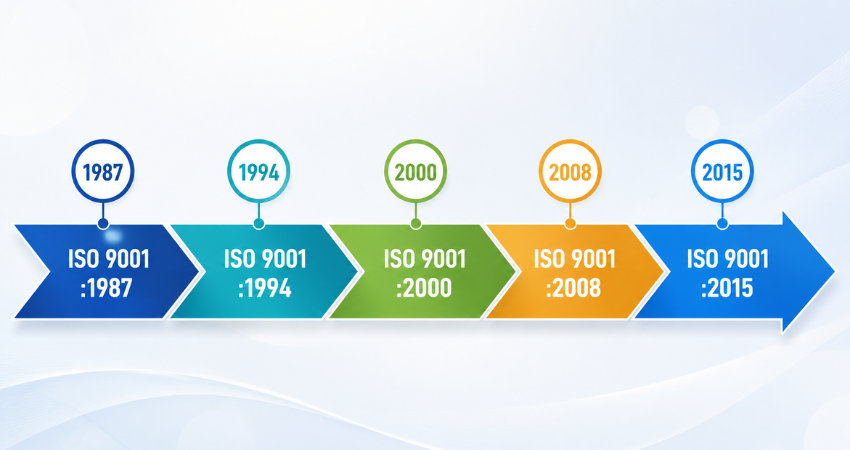
- ISO 9001:2000 marked a major change in the standard’s approach, shifting the focus toward process-based management, customer satisfaction, and continual improvement.
- ISO 9001:2008 primarily clarified and adjusted certain requirements of the 2000 edition to improve consistency and ease of implementation.
- ISO 9001:2015 is the current edition and introduced significant changes compared with previous editions, with greater emphasis on the organization’s context, risk-based thinking, leadership, and the process approach.
3. Key Features of ISO 9001:2015
This edition places greater emphasis on the organization’s context, risk-based thinking, leadership, and the process approach, while providing greater flexibility in establishing and maintaining a Quality Management System.
The key features of this edition include:
- Risk-based thinking is incorporated throughout the system, requiring organizations to identify and consider risks and opportunities that may affect the ability of the Quality Management System to achieve its intended results.
- The context of the organization is incorporated into the standard, requiring organizations to consider internal and external issues and relevant interested parties that may affect the organization’s purpose, direction, and ability to achieve the intended results of its Quality Management System.
- Leadership is given greater emphasis, highlighting leadership commitment, direction, and the integration of the Quality Management System into the organization’s overall operations.
- The process approach is emphasized through the identification, management, and control of interrelated processes, enabling organizations to better control inputs, outputs, resources, and process results.
- Organizational knowledge is incorporated into the standard, requiring organizations to determine and maintain the knowledge necessary for the operation of processes and for achieving conformity of products and services.
- Documented information replaces the distinction between “documents” and “records” used in previous editions, providing organizations with greater flexibility in determining and maintaining the information necessary for the Quality Management System.
- The High-Level Structure (HLS) provides the 2015 edition with a common structure aligned with other ISO management system standards, facilitating the integration of standards such as ISO 14001 and ISO 45001.
Expected Release of the New Edition in 2026
ISO 9001:2026 is expected to be published by ISO in September 2026. The Final Draft International Standard (FDIS) has been issued, and the voting process was completed in July 2026. The standard is currently undergoing finalization before its official publication.
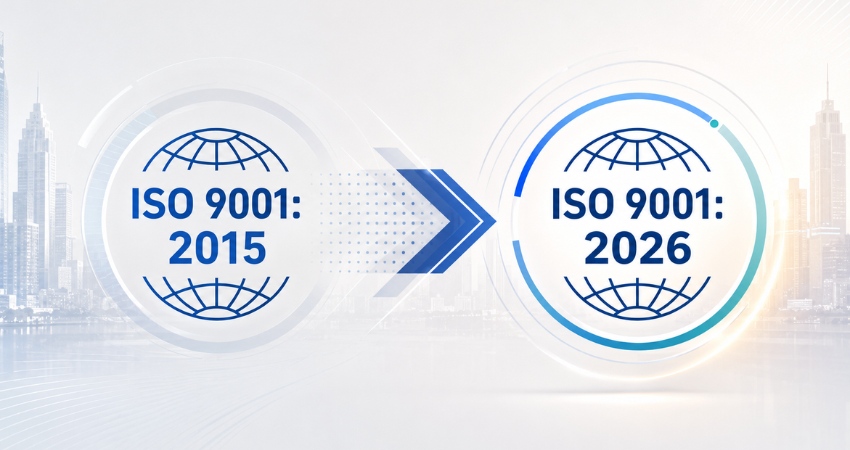
The new edition is based on the 2015 edition, with revisions intended to clarify requirements and enhance their relevance to the current quality management context. According to information from ISO, the new edition places greater emphasis on leadership, quality culture and accountability, risk and opportunity management, and introduces Annex A to provide clarification on the terminology and purpose of the requirements.
Note: Information regarding the new requirements is currently based on the FDIS and official information published by ISO. The content may be updated when the final edition is officially published.
4. Relationship Between ISO 9001 and Other Standards
ISO 9001 serves as a core foundation for an organization’s Quality Management System. In practice, organizations may need to manage various aspects beyond quality, such as environmental management, occupational health and safety, food safety, and information security. As ISO 9001 shares a harmonized structure with many other ISO management system standards, it can be integrated with these standards into a unified management system, depending on the organization’s industry and specific needs.
Some standards that can be integrated with ISO 9001 include:
- ISO 14001: Environmental Management System
- ISO 45001: Occupational Health and Safety Management System
- ISO 22000: Food Safety Management System
- ISO 13485: Quality Management System for Medical Devices
- ISO/IEC 27001: Information Security Management System
Different industries have different management requirements. Integrating appropriate standards can help organizations optimize their management systems and improve implementation effectiveness. Organizations should consult qualified experts to determine an approach that best meets their specific needs.
5. Quality Management System According to ISO 9001
The Quality Management System (QMS) according to ISO 9001 is a set of processes, resources, and methods established by an organization to manage and control quality-related activities. The system aims to meet customer requirements, maintain the conformity of products and services, and improve the effectiveness of quality management activities.
Under the standard, the processes within the system are interrelated, ranging from identifying the requirements of customers and relevant interested parties, providing resources, and delivering products or services to measurement, analysis, evaluation, and improvement. Leadership, resource management, and process control all contribute to achieving appropriate outputs.
The system is established based on the process approach and continual improvement, enabling organizations not only to control final results but also to manage the factors and processes that affect quality throughout their operations.
6. Seven Quality Management Principles of ISO 9001
ISO 9001 is based on seven quality management principles, which provide a foundation for establishing, operating, and continually improving an organization’s Quality Management System.
- Principle 1 – Customer Focus: Focus on identifying and meeting customer requirements and enhancing customer satisfaction.
- Principle 2 – Leadership: Establish a unified direction and objectives, and create conditions for people to participate in achieving quality objectives.
- Principle 3 – Engagement of People: Develop the competence and participation of people at all levels to create and deliver value.
- Principle 4 – Process Approach: Manage interrelated activities as processes within a unified system to achieve effective and efficient results.
- Principle 5 – Improvement: Continually improve the effectiveness and performance of the organization.
- Principle 6 – Evidence-Based Decision Making: Use appropriate data and information to analyze, evaluate, and make decisions.
- Principle 7 – Relationship Management: Manage relationships with relevant interested parties, particularly suppliers, to enhance the organization’s ability to create value.
7. The 10 Clauses of ISO 9001:2015
ISO 9001:2015 consists of 10 clauses, of which Clauses 4 through 10 specify the main requirements for the Quality Management System. The clauses are structured progressively, from determining the organization’s context and establishing direction and resources to system operation, performance evaluation, and improvement.
- Clause 1: Scope
- Clause 2: Normative References
- Clause 3: Terms and Definitions

- Clause 4: Context of the Organization: Identifying internal and external issues, relevant interested parties, the scope, and the processes necessary for the Quality Management System.
- Clause 5: Leadership: Addressing leadership commitment, the quality policy, and the assignment of responsibilities and authorities within the organization.
- Clause 6: Planning: Addressing risks and opportunities, establishing quality objectives, and planning changes to the Quality Management System.
- Clause 7: Support: Addressing resources, competence, awareness, communication, and documented information necessary for the system.
- Clause 8: Operation: Addressing the planning and control of processes for providing products and services that meet requirements, including design and development, externally provided processes, production, and control of nonconforming outputs.
- Clause 9: Performance Evaluation: Addressing monitoring, measurement, analysis, evaluation, internal audit, and management review.
- Clause 10: Improvement: Requiring organizations to identify opportunities for improvement, address nonconformities, and implement corrective actions.
→ Download the ISO 9001 Standard PDF here to learn more about the standard’s requirements and provisions.
8. Frequently Asked Questions About ISO 9001
No. ISO 9001 is not a mandatory requirement for all businesses. In general, the decision to implement and obtain ISO 9001 certification is voluntary. However, in certain cases, customers, business partners, or specific business requirements may require an organization to demonstrate that it has implemented ISO 9001 or obtained ISO 9001 certification.
ISO 9001:2015 can be applied to organizations of all types, regardless of their size, type of activity, or the products and services they provide. Therefore, the standard can be applied to manufacturing, trading, and service businesses, as well as organizations operating in various other sectors.
ISO 9001 certification is generally managed under a three-year certification cycle, with periodic surveillance audits conducted to maintain certification and a recertification audit conducted at the end of the certification cycle.
Risk-based thinking helps organizations identify and consider risks and opportunities that may affect their ability to achieve the intended results of the Quality Management System. Addressing risks and opportunities helps improve the effectiveness of the system, achieve better results, and prevent or reduce undesired effects.
Yes. The 2015 edition will remain valid during the transition period following the publication of the new edition. Organizations currently implementing the 2015 edition will have a transition period to move to the new edition in accordance with the applicable transition requirements.
** Conclusion
ISO 9001 is an international standard for Quality Management Systems, helping organizations manage their processes consistently, meet customer requirements, and maintain continual improvement. Based on seven quality management principles and comprising 10 clauses, the standard can be applied to various types of organizations and integrated with other management systems depending on the organization’s industry and specific needs.