

 VIE
VIE📌 Quick Summary
- ISO 45001 is an international standard for occupational health and safety (OH&S) management systems, helping organizations identify hazards, assess risks, and implement appropriate controls in the workplace.
- The standard applies to organizations of all types and sizes, with its requirements integrated into management processes according to each organization’s actual operations.
- To effectively manage OH&S, organizations need to identify sources of hazards, assess risks, and select appropriate control measures while monitoring, updating, and improving the system when changes or incidents occur.
1. ISO 45001 Standard
1.1 What Is ISO 45001?
ISO 45001 is an international standard for occupational health and safety (OH&S) management systems that specifies requirements to help organizations establish, implement, maintain, and continually improve their systems to prevent work-related injuries and ill health and provide a safe and healthy working environment.

The standard does not specify specific requirements for product safety, property damage, or environmental impacts. These issues are considered only to the extent that they may affect the occupational health and safety of workers.
1.2 Purpose of the System
The system helps organizations proactively manage occupational health and safety issues, prevent work-related injuries and ill health, and create a safe and healthy working environment.
The main objectives include:
- Preventing accidents and occupational diseases by reducing incidents, injuries, and health impacts arising during work.
- Controlling OH&S risks by identifying and controlling factors that may affect the safety and health of workers.
- Improving working conditions by progressively enhancing safety and protecting workers’ health in the workplace.
- Increasing worker participation in hazard identification, risk control, and activities related to occupational health and safety.
- Improving management effectiveness by monitoring results, evaluating performance, and continually improving the OH&S management system.
1.3 The 10 Clauses of ISO 45001:2018
The occupational health and safety standard is structured into 10 clauses. Clauses 1-3 cover the scope, normative references, and terms and definitions, while the main requirements for the occupational health and safety management system are set out in Clauses 4-10, including:
- Clause 4 – Context of the organization requires the organization to identify internal and external issues, the needs of workers, and relevant interested parties related to OH&S. Based on this, the organization determines the scope of its management system.
- Clause 5 – Leadership and worker participation addresses leadership roles and commitment, the OH&S policy, responsibilities within the system, and mechanisms for worker consultation and participation.
- Clause 6 – Planning focuses on hazard identification, assessment of risks and opportunities, determination of legal requirements, OH&S objectives, and plans for achieving those objectives.

- Clause 7 – Support covers the resources, competence, awareness, communication, and documented information needed for the management system to operate effectively.
- Clause 8 – Operation focuses on operational planning and control, management of change, procurement, contractors, outsourced processes, and emergency preparedness and response.
- Clause 9 – Performance evaluation requires the organization to monitor, measure, and evaluate OH&S performance, evaluate compliance, conduct internal audits, and carry out management reviews.
- Clause 10 – Improvement focuses on incidents, nonconformities, corrective actions, and continual improvement to enhance the effectiveness of the OH&S management system.
1.4 [Download PDF] ISO 45001 standard document
ISO 45001:2018 was officially published by ISO on March 12, 2018, replacing OHSAS 18001. The document provides the requirements of the standard, helping organizations understand the framework and develop or integrate an occupational health and safety management system into processes that are appropriate to their actual operations.
ISO 45001 is not a legally mandatory document. It is a management tool that organizations can voluntarily choose to adopt. The standard does not prescribe a fixed method for managing occupational health and safety. Instead, it provides a framework and requirements that organizations can apply according to their specific conditions, activities, and operational context.
=> Organizations can download the ISO 45001:2018 PDF to review the complete requirements and better understand the standard before developing or implementing an OH&S management system.
2. Relationship between ISO 45001 and OHSAS 18001
ISO 45001 and OHSAS 18001 are closely related through the development and transition of occupational health and safety management systems:
- OHSAS 18001 was the predecessor standard used by many organizations to establish occupational health and safety management systems before ISO 45001 was introduced.
- ISO 45001 was issued to replace OHSAS 18001 and became the international standard for occupational health and safety management systems.
- ISO 45001 inherits the management foundation from OHSAS 18001 with contents such as hazard identification, risk assessment and control, performance monitoring, and system improvement.
- ISO 45001 has a change in structure as it was developed according to the High-Level Structure (HLS), making the standard compatible with other management systems such as ISO 9001 and ISO 14001 and more convenient for integrating multiple systems within an organization.
3. Value of ISO 45001 certification
When an organization is awarded management system certification, it demonstrates that its occupational health and safety management system has been established and operates in accordance with the requirements of the standard.
Specifically, the organization can demonstrate that:
- An occupational health and safety management system has been established: OH&S-related activities are incorporated into a unified management system rather than being carried out separately.
- There is a mechanism for identifying and controlling risks: Hazards arising from work activities are identified, assessed, and controlled through appropriate measures.
- Leadership is committed to workers’ safety and health: Occupational safety is incorporated into the organization’s management activities, with the involvement of relevant levels.
- The system has undergone independent assessment: A certification body has assessed the organization’s management system and confirmed its conformity with the requirements of the standard.
The implementation and maintenance of the system can also help the organization proactively prevent accidents, minimize incidents that cause operational disruptions, and reduce losses related to occupational accidents.

However, having certification does not mean that the organization will not experience occupational accidents, nor does it automatically demonstrate that the organization has met all legal requirements for occupational safety.
4. How to Successfully Build an ISO 45001 Management System?
To build an effective management system, an organization needs to start by identifying factors that may generate hazards and developing appropriate methods for identifying, assessing, and controlling risks based on actual conditions.
4.1 Identifying Factors That May Affect Occupational Health and Safety
Hazards in the workplace can arise from various sources, including machinery, chemicals, environmental conditions, work organization, and factors related to workers. When planning the OH&S management system, the organization needs to fully consider sources that may cause injury or affect workers’ health.
The groups of factors commonly considered include:
- Physical factors: Noise, vibration, excessively high or low temperatures, radiation, pressure, inadequate lighting, and other physical conditions.
- Chemical factors: Dust, vapors, gases, fumes, and chemicals that may cause irritation, poisoning, fire, or explosion.
- Biological factors: Bacteria, viruses, fungi, insects, animals, or biological agents that may affect health.
- Ergonomic factors: Improper working postures, repetitive tasks, lifting or carrying heavy loads, and machinery or workstation designs that are unsuitable for users.
- Psychosocial factors: Work pressure, extended working hours, stress, violence, harassment, and other factors that may affect mental health.
- Factors related to work and the work environment: The condition of infrastructure, machinery, equipment, means of transportation, work organization, and abnormal or emergency situations such as fire, explosion, or chemical leakage.
The above groups are classifications that help organizations identify potential sources of hazards in practice; they should not be understood as a fixed list applicable to every organization. Each organization needs to identify hazards based on its activities, working conditions, and actual circumstances.
4.2 How ISO 45001 Addresses Hazards, Risks, and Incidents
ISO 45001 takes a proactive prevention approach, focusing on controlling hazards before they lead to accidents, injuries, or work-related illnesses. This process can be summarized into 5 steps:
Step 1: Identify hazards and determine risks
Identify hazards arising from each task, work area, and working condition. The identification should cover normal activities, abnormal activities, and emergency situations.
Step 2: Identify people who may be affected
The groups of people who may be exposed to hazards need to be identified:
- Workers in the work area.
- New employees or people with limited experience.
- Personnel performing maintenance or repair work.
- Contractors and external workers.
- Visitors who come to work or visit the site.
- Worker groups with specific characteristics that need to be considered separately.

Identifying groups of people who may be affected helps the organization select control measures appropriate to each type of work and actual working conditions.
Step 3: Assess the level of risk and select control measures
Assess the likelihood of occurrence and the severity of the consequences of each hazard to determine the level of risk and the order of control priorities.
Control measures are selected according to the hierarchy of controls, prioritizing the elimination or reduction of hazards at the source before applying engineering controls, administrative controls, and personal protective equipment.
Step 4: Record incidents and take corrective action
Record and investigate accidents, incidents, and near-misses to identify causes, evaluate control measures, and implement appropriate corrective actions.
The organization needs to determine:
- Under what conditions did the incident occur?
- Which hazard led to the incident?
- Are the current control measures effective?
- What are the direct causes and the causes related to the system?
- Are there similar risks in other areas or tasks?
The results of the analysis are used to adjust control measures and prevent similar incidents from recurring.
Step 5: Monitor, Update, and Improve
OH&S risk management needs to be maintained continuously, rather than being carried out only once when establishing the system.
Hazards and risks should be reassessed when there are changes in machinery, technology, processes, raw materials, or working conditions. The results of inspections, incidents, and workers’ feedback are used to improve the system.
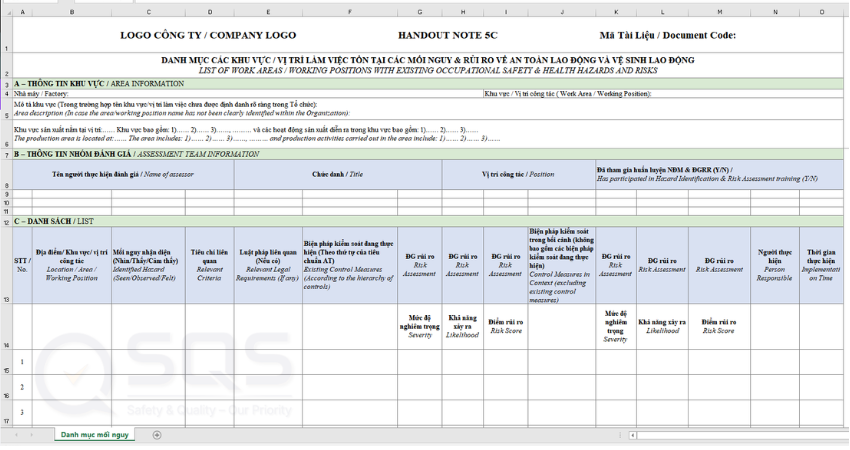
=> or convenience, organizations can refer to and download the Hazard Identification and Risk Assessment Checklist to support the hazard identification and risk assessment process.
6. FAQ – Frequently Asked Questions About ISO 45001
No. The implementation and certification of this standard are not mandatory requirements for every organization. However, organizations must still fully comply with applicable occupational safety and health laws and regulations related to their activities.
All three management systems apply to management systems but focus on different areas:
- ISO 45001: Occupational health and safety management.
- ISO 9001: Quality management.
- ISO 14001: Environmental management.
The standards have similar structures, so organizations can integrate them into a common management system.
The standard can be applied to organizations of all sizes and sectors, provided that the organization has activities requiring the management of occupational health and safety issues.
According to Vietnamese law, for facilities within the applicable scope, periodic assessments are carried out at least once a year, with additional assessments required when changes occur or serious accidents or incidents occur as prescribed.
It usually has a 3-year cycle. During this period, the system is subject to periodic surveillance assessments to maintain certification. At the end of the cycle, the organization may undergo a recertification assessment.
No. Certification only confirms that the management system has been assessed against the requirements of the standard; it does not replace the obligation to comply with occupational safety and health laws and regulations.
**Conclusion
ISO 45001:2018 provides a framework for organizations to manage occupational health and safety in a proactive and systematic manner. It helps organizations establish an OH&S management approach through a clear cycle: hazard identification → risk assessment → control → incident response → improvement.
Organizations implementing ISO 45001 should focus on its suitability for their actual operations and their ability to maintain the system. At the same time, all ISO 45001 requirements need to be implemented alongside the relevant legal regulations on occupational safety and health.